Token Atlas.
A local-first, privacy-bounded observability dashboard for understanding AI tool activity across multiple coding clients.
Why it exists.
Understanding AI tool usage should not require uploading private context to a service you do not control.
Multiple local coding clients each record their own prompts, responses, and token usage. Seeing the combined structure — how much work happens in which client, across which time windows — helps tune context, caching, and spending.
Token Atlas is local-first and privacy-bounded: collection runs on your own machines, transport is authenticated and private, and only a bounded, sanitized view is ever summarized for public explanation.
Implementation architecture.
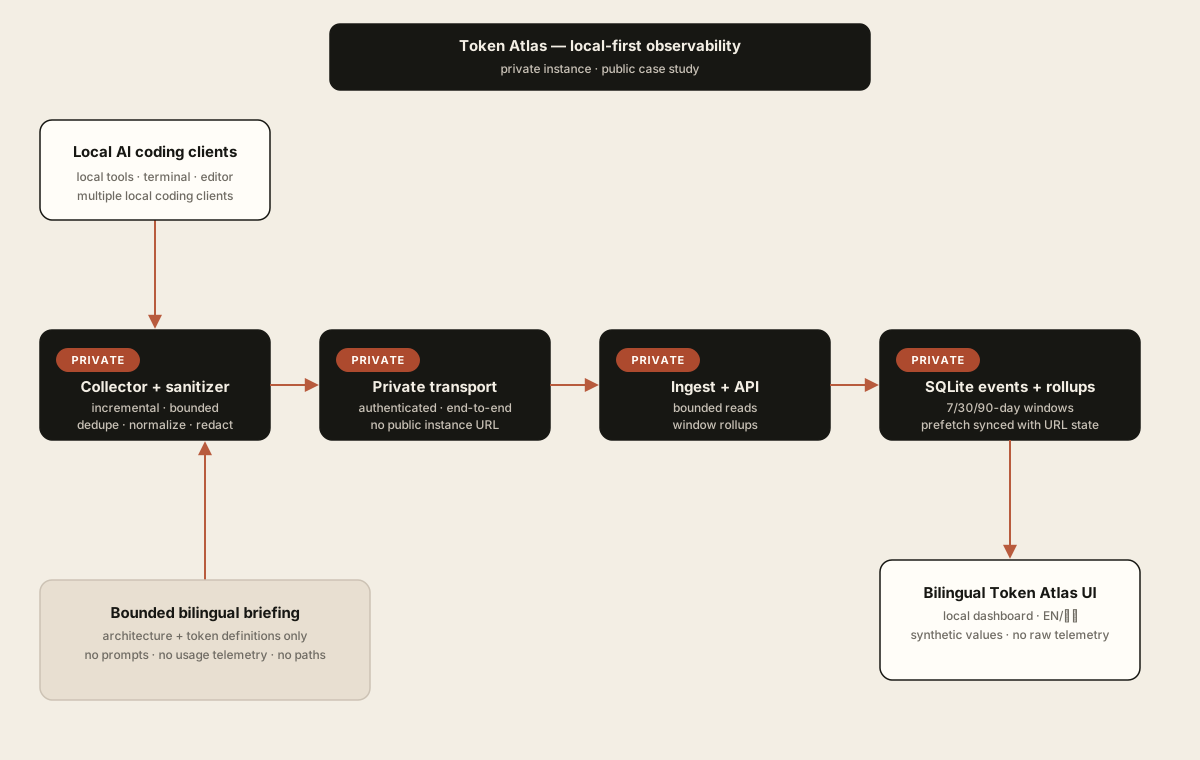
An incremental collector deduplicates, normalizes, and redacts events before they travel through an authenticated private transport to an ingest API that persists SQLite events and rollups.
How tokens are counted.
Two aggregates keep the metric clear and avoid double counting:
- Fresh Tokens = non-cached input + output + reasoning
- Processed Tokens = Fresh Tokens + cache reads
Cache input, cache output, and cache reasoning are mutually exclusive fields after normalization, so the same tokens are never added twice.
Time windows.
The dashboard offers 7-, 30-, and 90-day ranges. Selected ranges are prefetched in parallel and kept in sync with the URL state, so switching a range never mixes live API data with a stale static snapshot.
Honest boundaries.
Token Atlas is a case study about a private instance, not a published product demo.
- The public page publishes architecture and token definitions only; it never publishes real usage telemetry, prompts, responses, session labels, local paths, hosts, ports, databases, or credentials.
- Any illustrated values on this site are synthetic or value-free; they are not drawn from the running instance.
- No private instance URL is provided, and no access tokens are placed in the Pages repository.
- Normalization guarantees cache input, output, and reasoning are mutually exclusive before rollups, so Processed Tokens are not inflated by repeated counts.